MCP Builder’s Handbook: learn the Model Context Protocol step by step
A 66-page MCP tutorial in PDF form for developers: how MCP works, how it differs from REST and function calling, how to build and test an MCP server in Python, and how to secure it. Written for the current protocol revision, 2026-07-28.
Limited-period launch offer. Regular price ₹499. Pay ₹98 today.
- 66 pages: diagrams, comparison tables, checklists
- Tested Python MCP server: 9 tests passed, output printed
- Verified versions for 6 more technologies, clearly labelled
- Secure checkout by Razorpay (UPI and cards)
Preview Edition 0.1.0 · research cutoff 19 October 2026 · independent, not an official MCP publication.
- Instant PDF download
- Secure Razorpay checkout
- Python code tested: 9 tests passed
- Sourced and dated: 19 Oct 2026
What is MCP (Model Context Protocol)?
Model Context Protocol (MCP) is an open protocol that lets AI applications connect to tools and data through one standard interface.
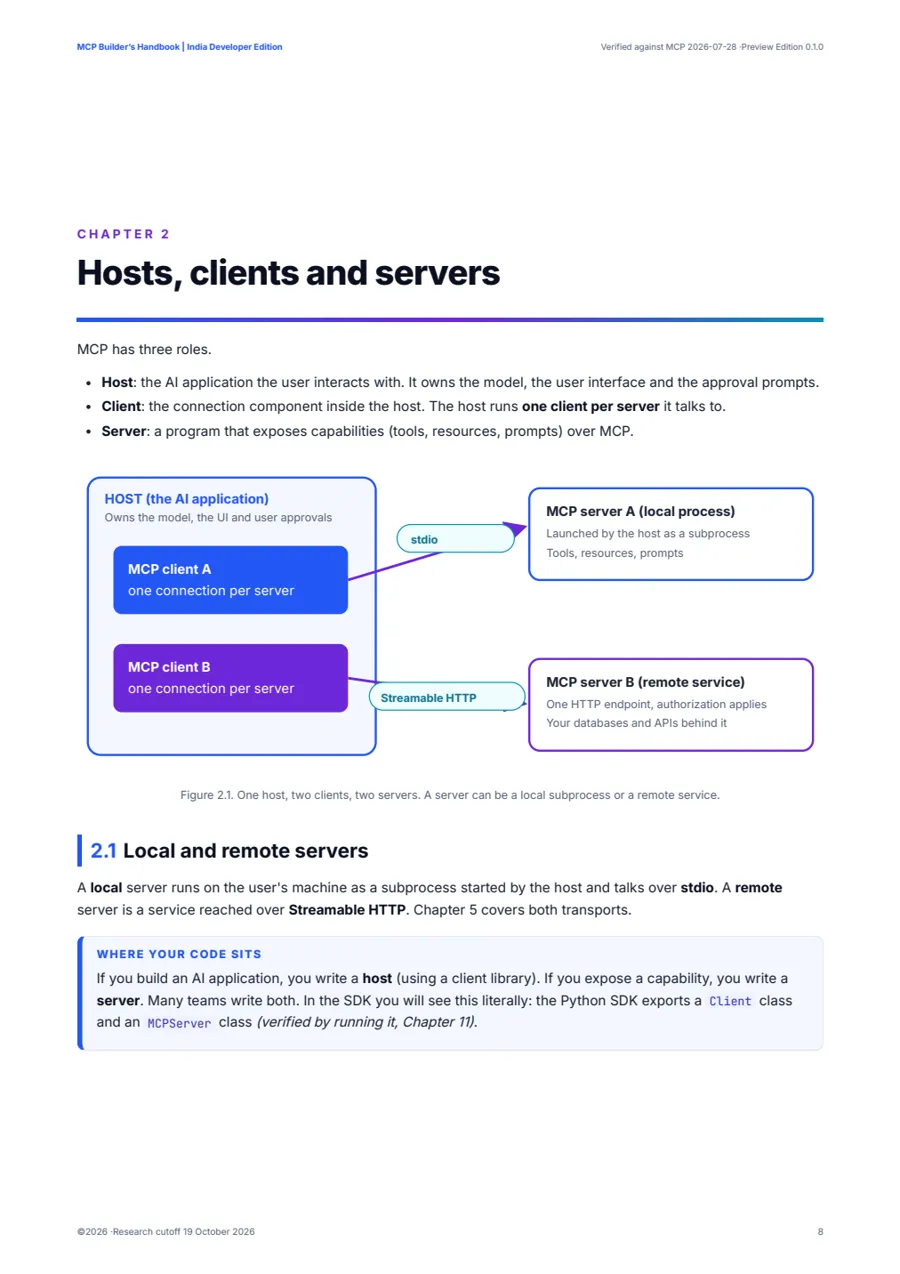
Instead of building a custom integration for every AI app and every system, you build one MCP server. Any MCP-capable AI application can then use it. The protocol uses JSON-RPC messages and defines three roles:
- Host: the AI application the user talks to.
- Client: the connection inside the host, one per server.
- Server: the program that exposes tools, resources and prompts.
Most MCP tutorials are already out of date
The official MCP site lists 2026-07-28 as the current protocol revision. It removed the old initialize handshake and connection sessions: every request now carries its own version and capabilities.
| Older tutorials (2025-11-25 and earlier) | This e-book (2026-07-28) | |
|---|---|---|
| Start of a connection | initialize request, then an initialized notification | No handshake |
| State | Connection-scoped session | Each request is self-contained |
| Version and capabilities | Negotiated once | Sent in _meta on every request |
| Discovery | Part of the handshake | Optional server/discover request |
The book also shows a real captured protocol exchange from a running Python MCP server, including a real error we hit along the way, so you see exactly what is on the wire.
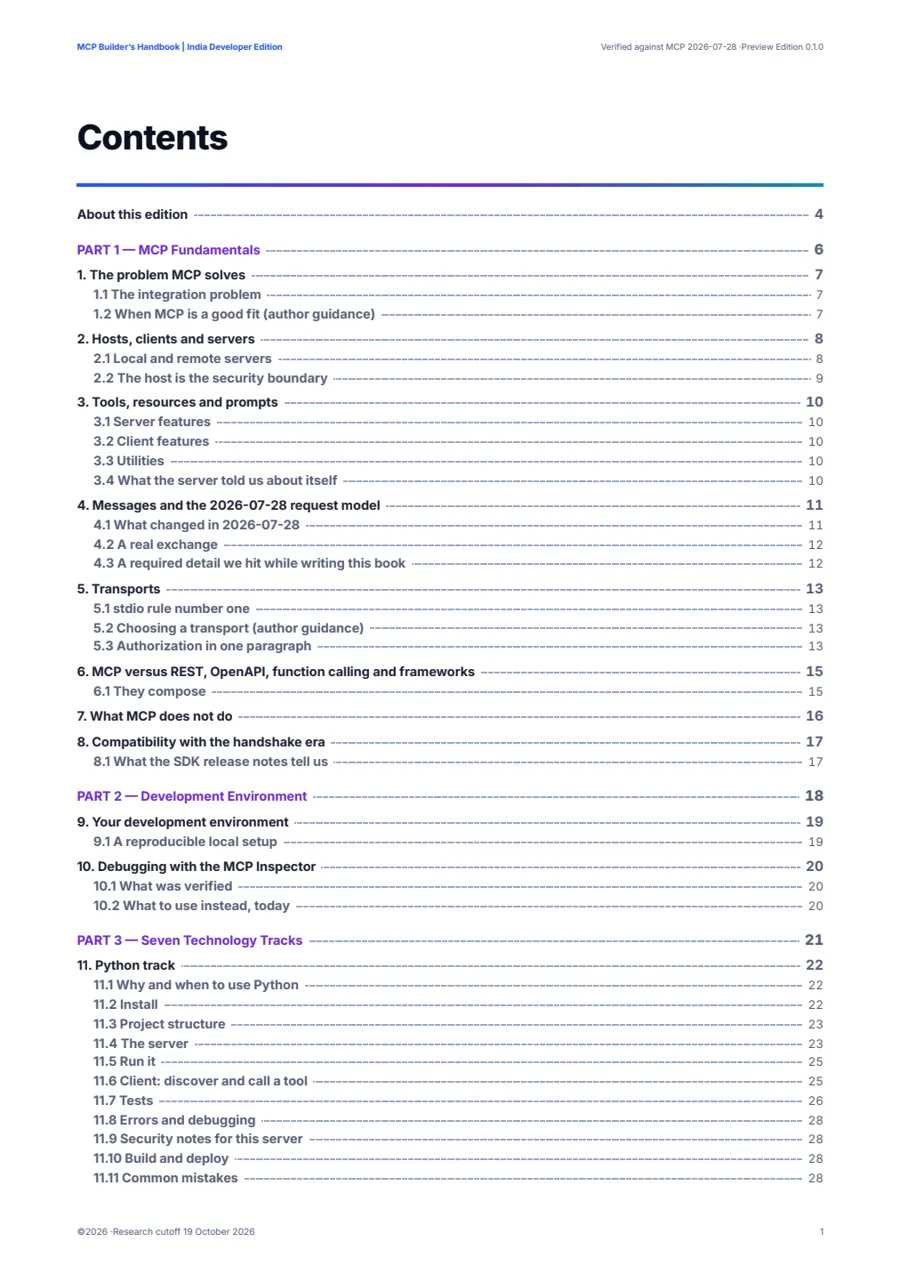
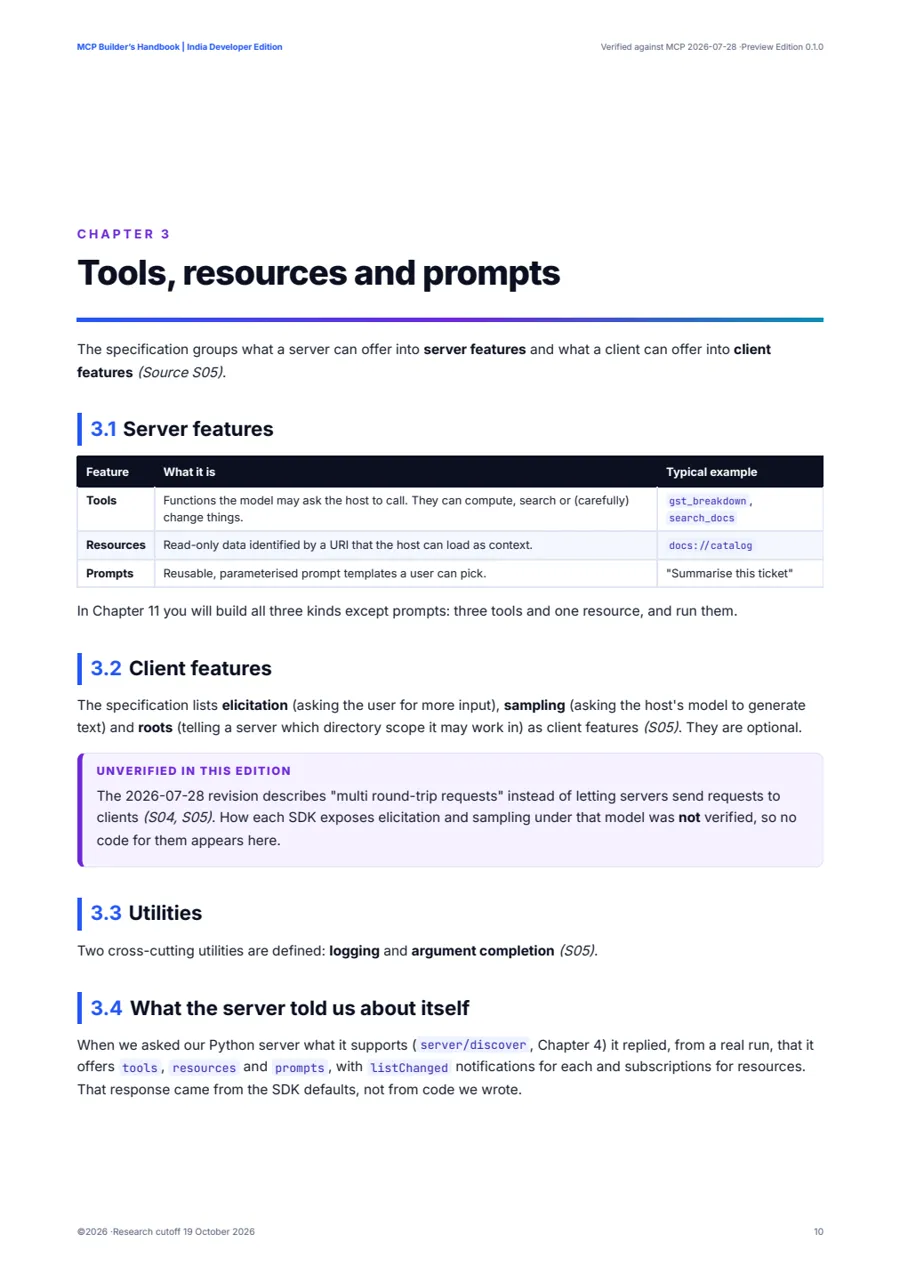
Real pages from the MCP e-book
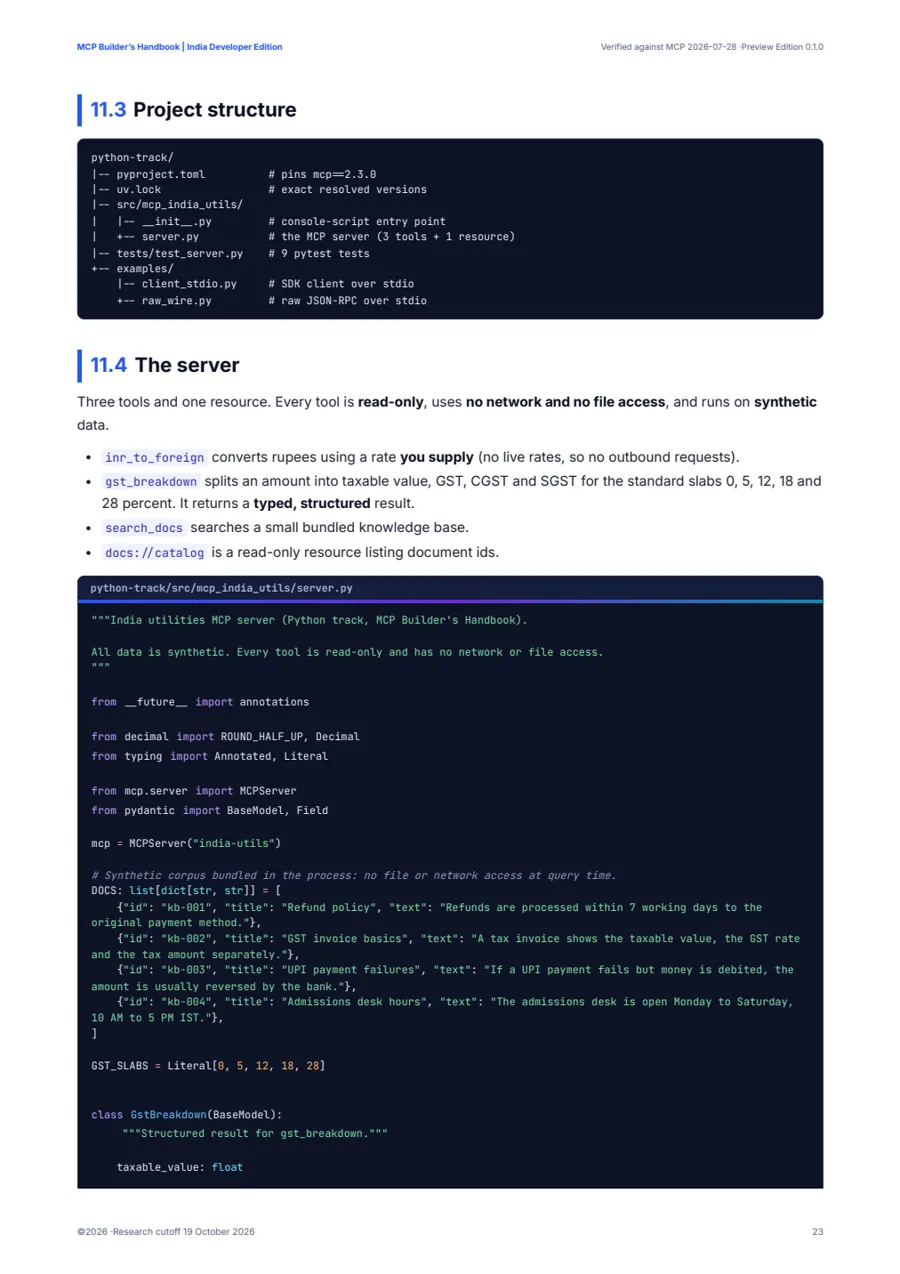
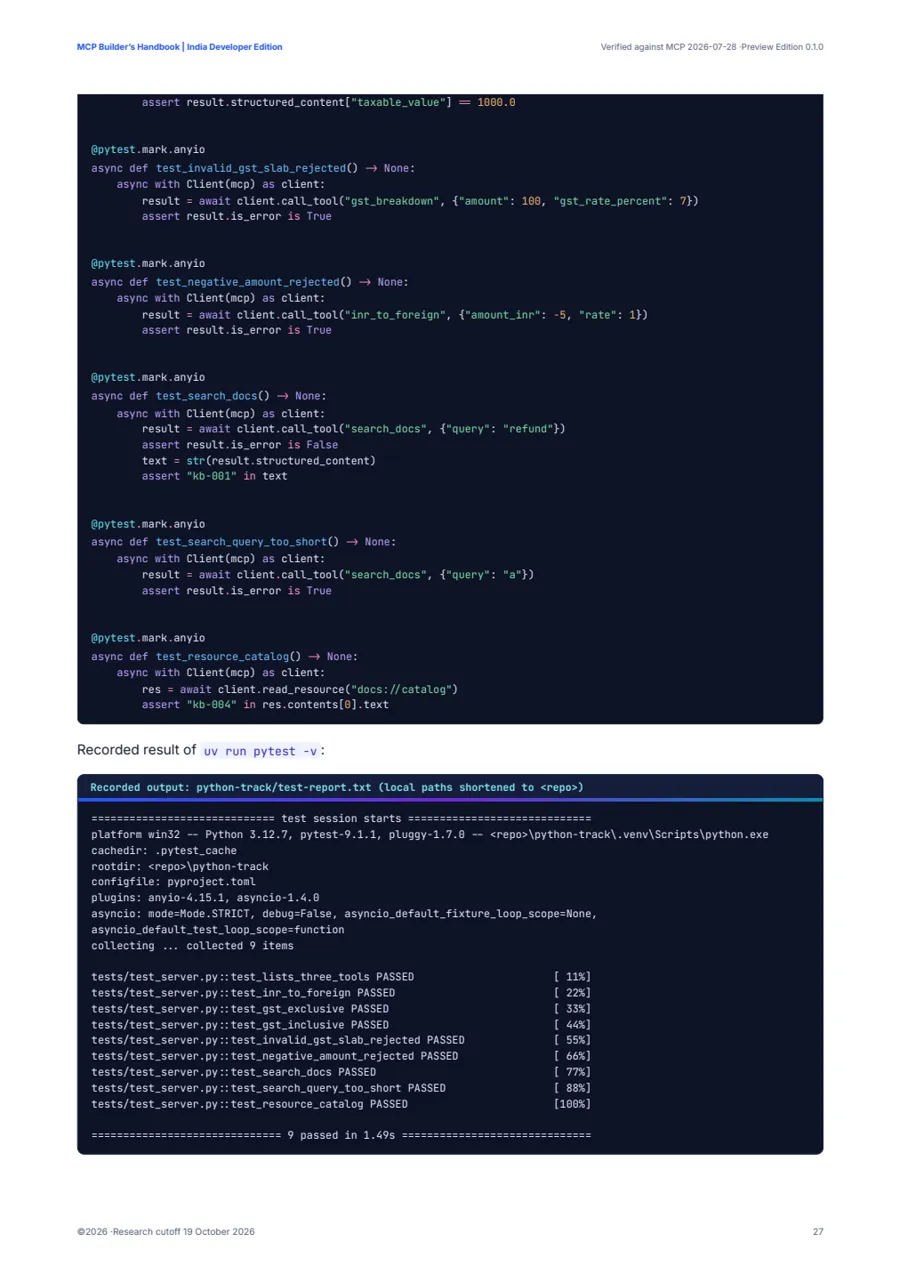
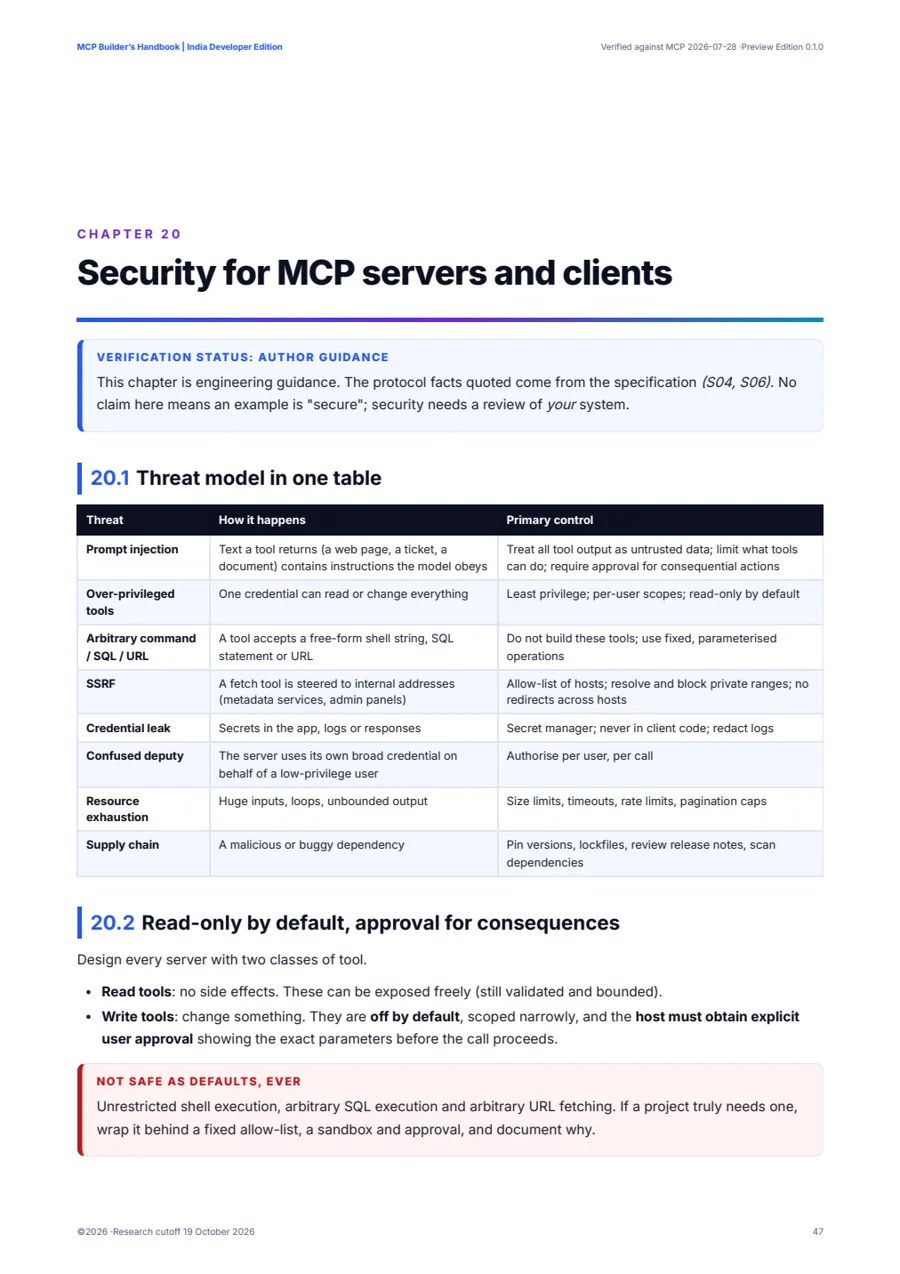
These are screenshots of the actual PDF pages, not mock-ups.
Inside the MCP Builder’s Handbook
Fundamentals that stay simple
Hosts, clients, servers, tools, resources, prompts, transports (stdio and Streamable HTTP) and what MCP does not do.
A tested Python MCP server
Three validated tools, a read-only resource, a stdio client, 9 passing tests and a raw protocol capture. Every file path and command is shown.
Security from day one
Prompt injection, SSRF, least privilege, read-only defaults, approval for risky actions, and why you never expose raw SQL, shell or URL tools.
Seven technology tracks
Verified versions and SDK maturity for Python, TypeScript, C#, Java, PHP/Laravel, Dart/Flutter and Go. No pretending they are all equal.
Web and mobile architecture
Why React and Flutter apps must never hold tool credentials, and the safe backend-in-the-middle design.
Career toolkit
A capstone brief, README template, portfolio checklist, interview exercises, common questions and a 30-day roadmap.
Full table of contents
26 chapters in 9 parts. Tap a part to expand.
Part 1: MCP fundamentals
- The problem MCP solves
- Hosts, clients and servers
- Tools, resources and prompts
- Messages and the 2026-07-28 request model
- Transports (stdio and Streamable HTTP)
- MCP versus REST, OpenAPI, function calling and frameworks
- What MCP does not do
- Compatibility with the handshake era
Part 2: Development environment
- Your development environment
- Debugging with the MCP Inspector
Part 3: Seven technology tracks
- Python track (tested code)
- TypeScript and Node.js track
- C# and .NET track
- Java and Spring Boot track
- PHP and Laravel track
- Dart and Flutter track
- Go track
- React, Flutter and mobile architecture
Part 4: Guided projects
- Guided projects: scope and safe designs (database, GitHub, docs search, business API, CRM, developer assistant, mobile app)
Part 5: Security and production
- Security for MCP servers and clients: prompt injection, SSRF, least privilege, secrets, audit logs
Part 6: Testing and deployment
- Testing, deployment and release checklist
Part 7: Product opportunities
- Product opportunities (clearly labelled business hypotheses)
Part 8: Capstone and career
- Capstone project, README template, portfolio checklist, interview questions, 30-day roadmap
Part 9: Reference
- SDK and compatibility matrix
- Known limitations and quality assurance
- Bibliography and source ledger
MCP vs REST API vs function calling: which should you use?
They are different layers and often used together. A quick summary from the e-book:
| Option | What it is | Choose it when |
|---|---|---|
| REST API | Resource-oriented HTTP interface | Any client needs a stable public contract |
| OpenAPI | A description of an HTTP API | You want docs, client generation and contract tests |
| Function calling | A model feature: the model emits a function name and arguments for your code to run | One application, a small fixed set of functions |
| MCP | A protocol so any compatible host can discover and call a server’s tools | Several AI hosts need the same capability |
Rule of thumb from the book: ask “who else, besides my own code, needs to call this?” If the answer is “nobody”, start without MCP.
Build an MCP server in Python: a taste of the code
This is a real tool from the e-book’s tested Python server (SDK package mcp 2.3.0). Validation lives in the type annotations, and the tests prove bad input is rejected.
- Amounts must be greater than 0 and bounded
- Money uses
Decimal, not floating point - No network or file access: the safest default
@mcp.tool()
def inr_to_foreign(
    amount_inr: Annotated[float, Field(gt=0, le=1_000_000_000, description="Amount in INR")],
    rate: Annotated[float, Field(gt=0, description="Units of foreign currency per 1 INR")],
) -> float:
    """Convert INR to a foreign currency using a rate supplied by the caller (no live rates)."""
return _money(Decimal(str(amount_inr)) * Decimal(str(rate)))What is tested and what is not
This is the Preview Edition. We tell you exactly where the line is, so you can decide with full information.
| Technology track | In the e-book | Code run and tested? |
|---|---|---|
| Python | Full chapter: server, client, tests, security notes | Yes, 9 tests passed |
| TypeScript / Node.js | Verified packages, versions, architecture guidance | Not yet |
| C# / .NET | Verified packages, versions, architecture guidance | Not yet |
| Java / Spring Boot | Verified SDK tier, versions, pre-release caveat | Not yet |
| PHP / Laravel | Verified packages, tier, two different packages explained | Not yet |
| Dart / Flutter | Honest picture: no official SDK, safe mobile architecture | Not yet |
| Go | Verified official SDK version and notes | Not yet |
Who this MCP e-book is for
- Backend, full-stack and AI engineers who will build or integrate MCP servers
- Python developers who want a first working server
- Students and freelancers building a portfolio project
- Team leads deciding whether MCP fits their architecture
Who should skip it
- You need tested TypeScript, C#, Java, PHP, Dart or Go code today (it is not in this edition)
- You want a video course or live mentoring
- You expect a job or salary guarantee (no book can give one)
MCP e-book FAQ
What is MCP (Model Context Protocol)?
MCP is an open protocol that lets AI applications (hosts) connect to tools and data (servers) through one standard interface, using JSON-RPC messages. A server can expose tools the model may call, resources it can read, and prompt templates. You write an integration once and any compatible AI application can use it.
Is this MCP tutorial up to date?
It is written for MCP protocol revision 2026-07-28, which the official site lists as the current revision as of 19 October 2026. That revision removed the old initialize handshake, which older tutorials still teach. SDK versions change quickly, so the e-book dates every version it quotes and tells you what to re-check.
Do I need to know AI or LLMs first?
No. The e-book assumes you know one programming language, Git, and basic HTTP and JSON. It explains the MCP concepts from scratch.
Which programming languages does it cover, and what is actually tested?
The Python chapter is fully tested: a server with three tools and a resource, a client, and 9 automated tests that passed, with the real output printed. The TypeScript/Node.js, C#/.NET, Java/Spring Boot, PHP/Laravel, Dart/Flutter and Go chapters contain verified package versions, official SDK tiers and architecture guidance, but not tested code. Each chapter carries a status badge.
Is the e-book in Hindi?
The e-book itself is in English. The payment page uses a Hindi and English (Hinglish) mix. Examples use Indian contexts such as GST and UPI, with synthetic data only.
Can I really learn MCP in one day?
A Python developer can follow the Python chapter to run a first MCP server in about a day. How fast you learn depends on your practice, and no learning time, job or salary outcome is guaranteed.
What format is it and how do I get it?
It is a PDF of 66 pages (about 2 MB). After you pay on the secure Razorpay page (UPI and cards), you receive the download link on the confirmation page and by email.
What if the file does not arrive or I am charged twice?
Contact support with your payment ID and we will fix it or refund it. Because it is a digital product delivered instantly, other refunds are not offered after download. Full details are in the Terms & Conditions.
Is this an official MCP product?
No. It is an independent e-book. It is not endorsed by the MCP project or by any SDK or framework vendor mentioned in it.
Read more about MCP
- What is MCP (Model Context Protocol)? A simple explanation
- MCP 2026-07-28: what changed and why older tutorials are out of date
- Build an MCP server in Python: step-by-step tutorial
- MCP vs REST API vs function calling
- MCP security checklist: prompt injection, SSRF, least privilege
- MCP cheat sheet (2026-07-28)
Start building with MCP today
66-page PDF · instant download · ₹98 ₹499 · 80% off, limited-period launch offer
Secure payment by Razorpay (UPI and cards). Digital product: see Terms & Conditions for delivery and refunds.